Name: Thabo Ndaba
Student Number: 19333551
Course: DSDM
Module: DIGC5110
Assessment Type: Task 1
Lecture: Jessel
Submission Date: 01 October 2019
Contents
Q.1.1 Nine elements of digital citizenship … 3
Q.1.2 Digital citizen enhance social capital … 3
Q.2.1 Properties of digital citizen … 5
Question 1
Digital Access and Divide
Q.1.1 Nine elements of digital citizenship
The IIE (2019), contends that the nine features form the structure of this manual, joint with the hypotheses of the fluencies of digital citizenship. The elements are:
- Digital Access – full electronic performance by the society.
- Digital Commerce – electronic buying and selling of goods and services using digital channels.
- Digital Communication – electronic swap of information.
- Digital Literacy – ability to use communication technologies and data to communicate, create, evaluate and find information.
- Digital Etiquette – collection of rules relating to the behaviour that is needed to comply with to make sure the Internet is healthy for users.
- Digital Law – electronics responsibility for what is done electronically, whether it ii unethical or ethical.
- Digital Rights and Responsibilities – freedom and privileges extended to digital technology users, and behavioural anticipations that come with them.
- Digital Health and Wellness – psychological and physical wellbeing in a technological world.
- Digital Security – to ensure the proficiency to use digital data and digital information systems without being interfered.
Q.1.2 Digital citizen enhance social capital
The IIE (2019), claims that social capital is the compendium value of various social networks and feeling that ascend from networks to work together and do things for each other. The core principle for social capital is that social networks creates and retains value.
The IIE (2019), says that
digital citizen builds the social capital that has increased and continues to escalate
our communication and social skills. As a result, we are growing our digital
literacy, whereas we are increasing our psychological comfort, as we feel respected
and connected through engaging with people. The value benefited from online alliance would impact the digital
citizenship on people’s ability to be responsible and behave appropriately with
regard to the usage of technology.
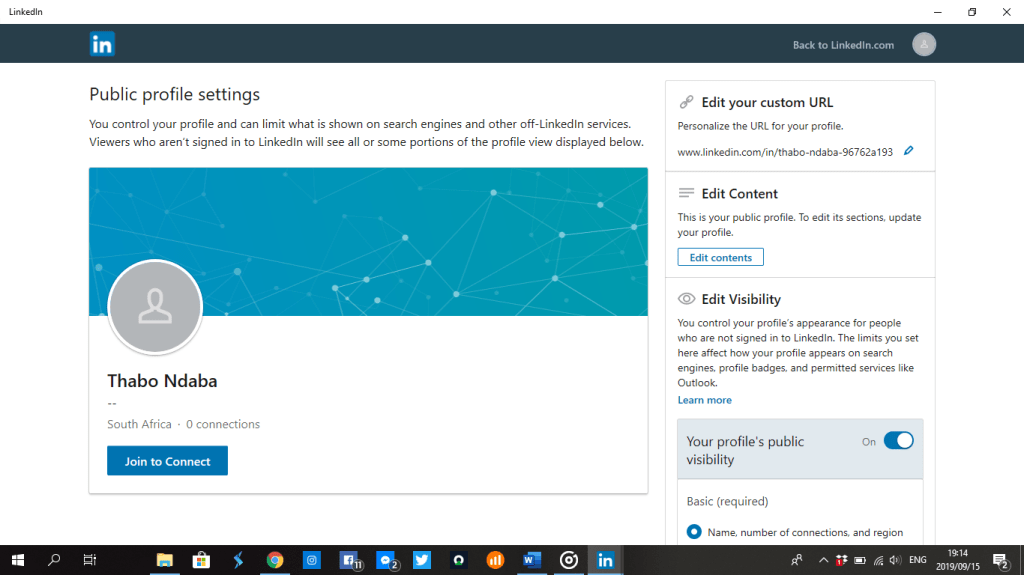
Q.1.3 LinkedIn account
Link: www.linkedin.com/in/thabo-ndaba-96762a193
Question 2
Digital Literacy
Q.2.1 Properties of digital citizen
The IIE (2019), claims that technology is the quickest developing and altering industries that influences in how we live, work and socialise. The Global Digital Citizen Foundation gathered support on digital citizenship, comprising the following factors:
- Digital Footprints – word used to describe the footprints, traces or trails that people leave online. Tools like Pipl, Digital Footprint Quiz, Internet Society: Your Digital Footprint Matters and Peekyou could help students to establish more about how the digital footprint is managed and how it works.
- Citing Sources – to give credit to another person’s work. It is a good ethical practise whereas credit is given where credit is due. BibMe, Citation Machine and EasyBib can support both students and lectures/teachers with the cumbrous process of creating a reference list citation.
- Cyberbullying – defined as ‘cyberharassment’, whereas it is a method of harassment or bullying using electronic means. It is mainly known as online bullying, where it has become universal, especially amongst teenagers.
- Plagiarism – it is described as “stealing” and “wrongful appropriation” of someone else’s work, language, ideas, expressions or thoughts, and exemplifying them as your own original work. Plagiarism is reflected as academic dishonesty. TurnItIn, Safe Assign, DOC Cop and Plag Tracker are tools that can be used to deter plagiarism.
- Personal Responsibility – individual accountability that people instigate their own actions. It is about how one control themselves in moral and ethical situations. It includes carrying for your mind, body and spirit.
Q.2.2 Digital footprint
Mudrakola (2018), disputes
that considering that our lives are intertwined with technology and internet,
it starts to feel like the extension of oneself. One’s personal information can
be used to generate income without your knowledge. The digital footprint
creates an environment of ‘loss of privacy’. Your identity can be revealed and
shared amongst strangers without your awareness. Digital footprints cannot be
deleted or removed, as they are permanent. Candidates can be blackmailed based
on their past searches.
Reference List
Mudrakola, S. 2018. Digital Footprints: Control How Much the Internet Knows About You, TechGenix, 19 October 2018. [Blog]. Available at: http://techgenix.com/digital-footprints-control/ [Accessed 15 September 2019].
The IIE. 2019. Digital Citizenship [DIGC5110 Module Manual]. The Independent Institute of Education: Unpublished.

