Be yourself; Everyone else is already taken.
— Oscar Wilde.
This is the first post on my new blog. I’m just getting this new blog going, so stay tuned for more. Subscribe below to get notified when I post new updates.
Be yourself; Everyone else is already taken.
— Oscar Wilde.
This is the first post on my new blog. I’m just getting this new blog going, so stay tuned for more. Subscribe below to get notified when I post new updates.
Mudrakola (2018), disputes that considering that our lives are intertwined with technology and internet, it starts to feel like the extension of oneself. One’s personal information can be used to generate income without your knowledge. The digital footprint creates an environment of ‘loss of privacy’. Your identity can be revealed and shared amongst strangers without your awareness. Digital footprints cannot be deleted or removed, as they are permanent. Candidates can be blackmailed based on their past searches.
The IIE (2019), claims that technology is the quickest developing and altering industries that influences in how we live, work and socialise. The Global Digital Citizen Foundation gathered support on digital citizenship, comprising the following factors:
The IIE (2019), claims that social capital is the compendium value of various social networks and feeling that ascend from networks to work together and do things for each other. The core principle for social capital is that social networks creates and retains value.
The IIE (2019), says that digital citizen builds the social capital that has increased and continues to escalate our communication and social skills. As a result, we are growing our digital literacy, whereas we are increasing our psychological comfort, as we feel respected and connected through engaging with people. The value benefited from online alliance would impact the digital citizenship on people’s ability to be responsible and behave appropriately with regard to the usage of technology.
The IIE (2019), contends that the nine features form the structure of this manual, joint with the hypotheses of the fluencies of digital citizenship. The elements are:
Name: Thabo Ndaba
Student Number: 19333551
Course: DSDM
Module: DIGC5110
Assessment Type: Task 1
Lecture: Jessel
Submission Date: 01 October 2019
Contents
Q.1.1 Nine elements of digital citizenship … 3
Q.1.2 Digital citizen enhance social capital … 3
Q.2.1 Properties of digital citizen … 5
The IIE (2019), contends that the nine features form the structure of this manual, joint with the hypotheses of the fluencies of digital citizenship. The elements are:
The IIE (2019), claims that social capital is the compendium value of various social networks and feeling that ascend from networks to work together and do things for each other. The core principle for social capital is that social networks creates and retains value.
The IIE (2019), says that
digital citizen builds the social capital that has increased and continues to escalate
our communication and social skills. As a result, we are growing our digital
literacy, whereas we are increasing our psychological comfort, as we feel respected
and connected through engaging with people. The value benefited from online alliance would impact the digital
citizenship on people’s ability to be responsible and behave appropriately with
regard to the usage of technology.
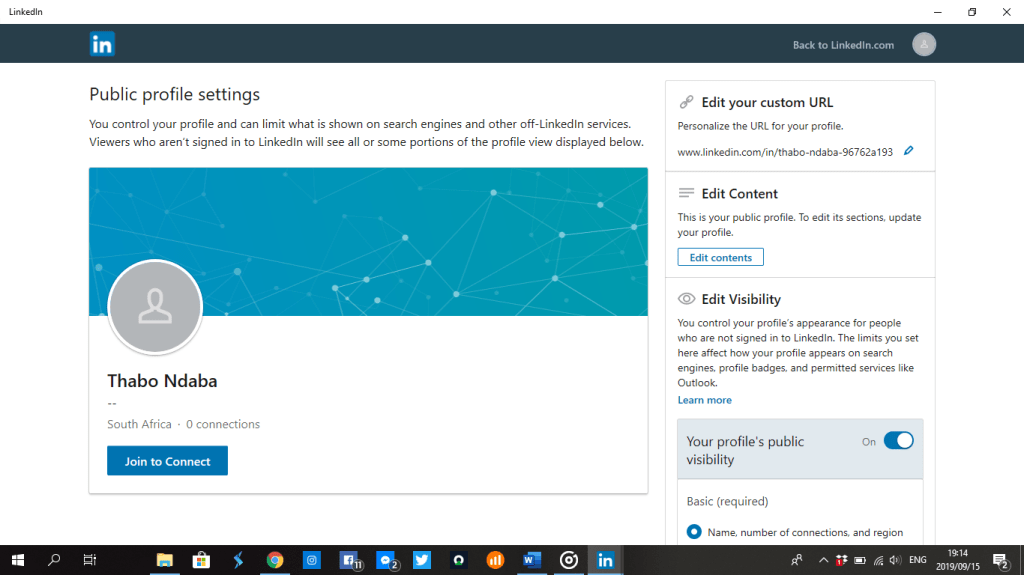
Link: www.linkedin.com/in/thabo-ndaba-96762a193
The IIE (2019), claims that technology is the quickest developing and altering industries that influences in how we live, work and socialise. The Global Digital Citizen Foundation gathered support on digital citizenship, comprising the following factors:
Mudrakola (2018), disputes
that considering that our lives are intertwined with technology and internet,
it starts to feel like the extension of oneself. One’s personal information can
be used to generate income without your knowledge. The digital footprint
creates an environment of ‘loss of privacy’. Your identity can be revealed and
shared amongst strangers without your awareness. Digital footprints cannot be
deleted or removed, as they are permanent. Candidates can be blackmailed based
on their past searches.
Mudrakola, S. 2018. Digital Footprints: Control How Much the Internet Knows About You, TechGenix, 19 October 2018. [Blog]. Available at: http://techgenix.com/digital-footprints-control/ [Accessed 15 September 2019].
The IIE. 2019. Digital Citizenship [DIGC5110 Module Manual]. The Independent Institute of Education: Unpublished.
Listening
The music and sound effects of the video flows along with the players’ movement with the ball on feet, players tackling, and goalkeepers attempting a save to prevent the ball from going past the goalpost.
The sound effects were able to create the surprising energy whereas the image of the video was flowed along.
Communication
The video used was able to communicate with the audience in various ways, as the youth will take is as motivation, the supporters would develop great loyalty for the club they stand for, entrepreneurs would take it as a ‘time-off’ work, etc.
The form of the video accommodated anyone who would be interested in watching it. From people who are experiencing visual issues, to those who are not.
The ‘story’ presented had a blasting exposition whereas it sparked the craving to be interested to watch the video. The sound effects were able to form a great deal of a rising action, whereas as soon as it got to the climax, everything was a wonder.
The end of the video created an environment whereas the viewer will crave and seek for more content to watch.
Not every candidate is as fortunate as the other, as there is a digital imbalance in my area, (WhatIs 2014).
There people who have access to technological devices, and those who do not; those candidates who are unfortunate to access digital devices, lack the capability to the usage of modern information technology, (WhatIs 2014).
The digital divide is highly emphasised in cities and rural areas, between the uneducated and the educated, and between less and more industrialised areas. The technology includes modern television, telephones and cell phones (smart phones), the internet, and personal computers, (WhatIs 2014).
There are a couple of homes who are more advance technologically, and there are one’s in which are underdeveloped. Fortunate candidates make use of Wi-Fi services with a purpose, whereas the disadvantaged are not as well-armed to equip one. The old school make use of hardcopy newspapers, as the new generation have adapted to technological changes, (WhatIs 2014).
The adaption to the new digital space would improve the democracy, literacy, economic growth, economic equality, and social mobility, (WhatIs 2014).
Reference List
WhatIs. 2014. Digital Divide, 18 June 2014. [Online]. Available at: https://www.google.com/amp/s/whatis.techtarget.com/definition/digital-divide%3famp=1 [Accessed 6 August 2019].
This is an example post, originally published as part of Blogging University. Enroll in one of our ten programs, and start your blog right.
You’re going to publish a post today. Don’t worry about how your blog looks. Don’t worry if you haven’t given it a name yet, or you’re feeling overwhelmed. Just click the “New Post” button, and tell us why you’re here.
Why do this?
The post can be short or long, a personal intro to your life or a bloggy mission statement, a manifesto for the future or a simple outline of your the types of things you hope to publish.
To help you get started, here are a few questions:
You’re not locked into any of this; one of the wonderful things about blogs is how they constantly evolve as we learn, grow, and interact with one another — but it’s good to know where and why you started, and articulating your goals may just give you a few other post ideas.
Can’t think how to get started? Just write the first thing that pops into your head. Anne Lamott, author of a book on writing we love, says that you need to give yourself permission to write a “crappy first draft”. Anne makes a great point — just start writing, and worry about editing it later.
When you’re ready to publish, give your post three to five tags that describe your blog’s focus — writing, photography, fiction, parenting, food, cars, movies, sports, whatever. These tags will help others who care about your topics find you in the Reader. Make sure one of the tags is “zerotohero,” so other new bloggers can find you, too.
Have a WordPress.com account? Log in now.

